ZAMBAKET
The Great Bazaar of Gjakova — A city built by crafts
A late sixteenth-century endowment, hundreds of workshops and guilds that built bridges: how an economy of crafts shaped the streets, the rows of shops and the scale of a city.
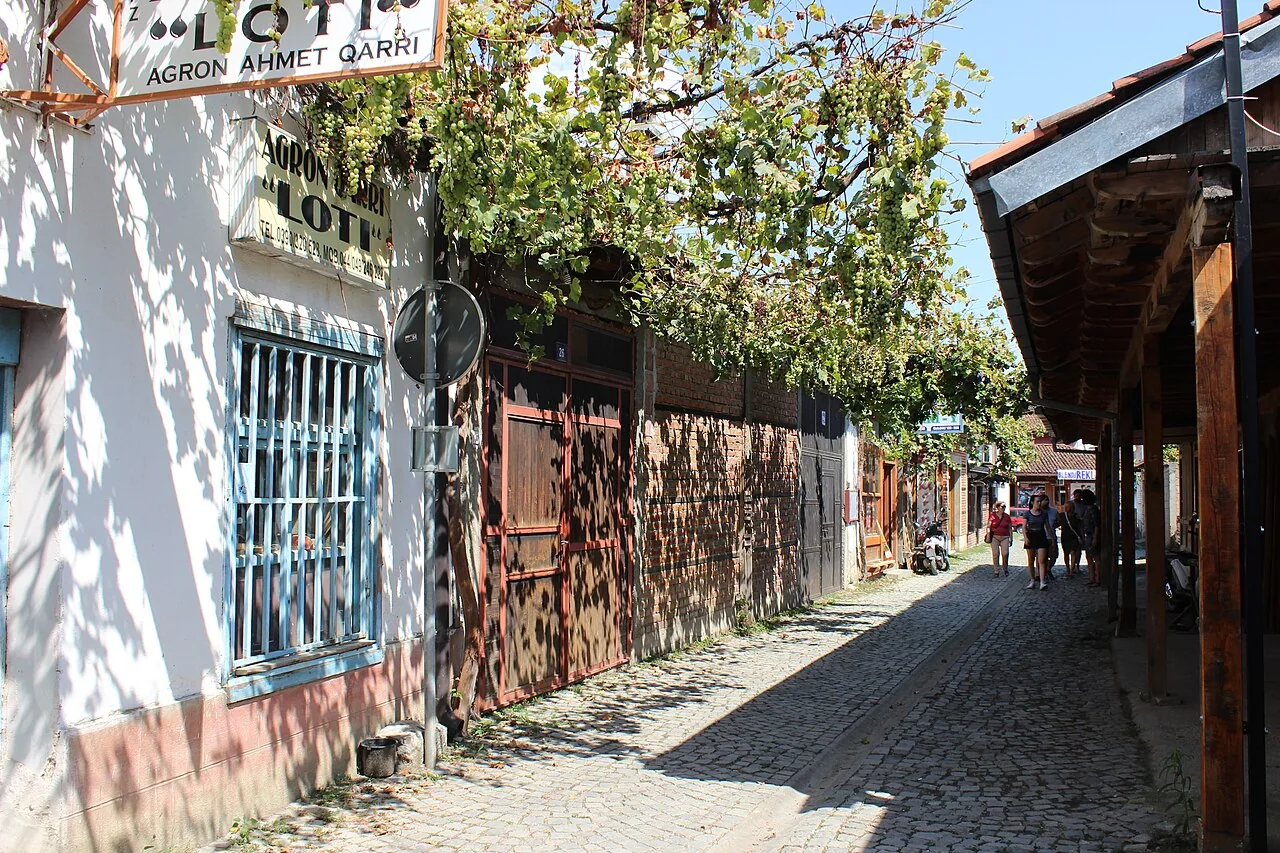
Most cities contain their market. Gjakova is the opposite case: the city grew out of the market. The Great Bazaar is not a commercial quarter added later, but the core from which the historic city was born.
This article, the third in the "Heritage of Dukagjini" series, reads the bazaar as an urban structure: how it formed, how it is organised, what it was built with, and why crafts, more than any plan, gave it its shape.
From village market to kasaba
Gjakova is mentioned as a market place as early as 1485, and in the Ottoman registers of the Sanjak of Shkodra of 1582 it still appears as a village with commercial activity. The turning point came in 1594–1595 (1003 in the Hijri calendar), with the construction of the Hadum Mosque ensemble: the mosque, a religious school, a library, an inn, a bath, a timekeeper’s room and the shops where the first craftsmen settled. According to the study by CHwB Kosovo, this ensemble forms the core of the bazaar.
When the Ottoman traveller Evliya Çelebi visited Gjakova in 1662, he recorded about 300 shops. At its height, the bazaar counted more than 500 built structures: the CHwB study lists 525 buildings, while the study by EC Ma Ndryshe puts its area at about 2.6 hectares, within the boundary defined by CHwB.
The bazaar’s wealth depended on trade routes. Trade with Shkodra remained strong until the 1870s, when the Thessaloniki–Skopje–Mitrovica railway (1873) shifted the flow of goods eastwards. After its destruction in the Balkan Wars of 1912, the decline of crafts between the two world wars and the move of factories to the left bank of the Krena after the Second World War, the bazaar lost its role as the city’s economic centre.
Street, row and river
The bazaar runs along the Krena river, near Çabrati hill, and is linked to the eastern bank by several bridges. Its structure is linear and organic: a main street and secondary streets that still carry the names of trades, such as the Street of the Box-makers (Kutixhinjve) and the Street of the Quilt-makers (Jorganxhinjve), alongside Ismail Qemali Street, with the Grain Square (Lama e Drithit), and Abedin Tërbeshi Street.
A 2014 thesis by Arnisa Kryeziu at the Izmir Institute of Technology describes the bazaar as one of the rare open-air bazaars that keep their original urban organisation: shops in rows with narrow streets between them, shaped by Ottoman-period characteristics and local expression.
Above this everyday rhythm rise the buildings that give the bazaar its landmarks: the Hadum Mosque complex, the Clock Tower, the Tekke of Sheh Emin, the Bektashi Tekke, the Great Madrasa, the Red Mosque, the houses and towers of prominent families, and the Haraçia Inn. The shops set the scale of the street; these buildings set its hierarchy.
Wall, timber and tile
The sources available online do not yet offer a full constructional description of the traditional Gjakova shop. They do, however, provide two important pieces of evidence. The first comes from the Kosovo Cultural Heritage Project report by Andrew Herscher and András Riedlmayer, prepared after a field survey in October 1999: the fires brought down the roofs, but the walls between the shops mostly remained standing. This points to massive party walls and timber roof structures.
The second comes from CHwB Kosovo’s guidelines for interventions in the bazaar. The materials named for new walls and for adapting existing ones are brick, timber, lime, with white as the dominant colour, and traditional curved roof tiles. Doors should keep their original forms and proportions, and conservation should respect the silhouette of the area, its plots, proportions, materials and roof morphology.
The monumental buildings follow a different logic. According to the same KCHP report, the Hadum Mosque had an eighteenth-century timber portico and lead-covered roofs over the portico and its three small domes, which melted in the fire of 1999.
Crafts as urban planners
In Gjakova, economic organisation and urban form are almost the same thing. The EC Ma Ndryshe study lists tailors, jewellers, box-makers, quilt-makers, tinsmiths and other trades. The CHwB study describes the crafts as a chain of production and trade spanning metal, leather, textiles and timber. The street names still preserve this geography of trades.
The guilds were more than professional associations. According to CHwB, they were central to the city’s social and economic structure, and in the eighteenth century the tailors’ and tanners’ guilds gained power even over local authorities. That power turned into infrastructure: recent research treats Gjakova’s eighteenth-century stone bridges as guild investments made to ease trade.
In Gjakova, the urban plan was not drawn by an administration. It was written by the trades, row by row.
Fire, reconstruction and the question of authenticity
On the night of 24–25 March 1999 the bazaar was set on fire. The KCHP report found that the destruction was not the result of aerial bombardment but of fires set on the ground in individual buildings. Nearly all the shops in the protected historic area burned out, except for one row of shops on Abedin Tërbeshi Street. The library beside the Hadum Mosque burned as well, together with its manuscript collection.
Reconstruction was fast, between 2000 and 2002, based largely on the study of 1979–1982 and with limited time for detailed design. The Hadum Mosque was restored in 2003–2005 under CHwB’s management. Physical reconstruction, however, did not bring back economic life: in CHwB’s 2015 survey, 146 of the 436 shops on the main streets were closed and 60 buildings had still not been rebuilt. EC Ma Ndryshe records the removal of the cobblestones on the central street in 2012 as a loss of authenticity.
The state Cultural Heritage Database records the Great Bazaar urban ensemble under permanent protection, referring to decision No. 59/55 of 19 February 1955 (record 000334). The EC Ma Ndryshe study also notes its inclusion on the 2023–2024 temporary list and uncertainty over the protective boundary and buffer zone at the time of that study. This does not establish the state of boundaries in 2026, which requires confirmation against the latest official plan.
The value of the whole
The bazaar’s value does not lie in a single building but in the whole: the endowment, the crafts, the street, the river and the bridges form one system. That is precisely why it is protected as an urban ensemble rather than as an isolated monument. It is at once the historical record of an economy, an urban model and a place where the surviving crafts still work.
Editorial opinionFor architecture today, the Gjakova bazaar offers a lesson often forgotten in new commercial projects: the small, repeated scale of the shop, the mix of making, selling and living on the same street, and a public space that belongs to the pedestrian. The greatest risk today is not fire but emptiness: closed shops and interventions that copy the form without understanding its logic.
Preserving the bazaar is as much a matter of economic planning as of conservation. Without its crafts and its daily life, even the most careful reconstruction remains stage scenery.
Sources
- CHwB Kosovo; Bakija, D. & Nushi, D. Hapësira Historike Urbane — Korniza e funksionalizimit për Çarshinë e Madhe në Gjakovë (process started in 2015; year of publication not printed). https://chwbkosova.org/wp-content/uploads/2015/09/Publication_2015_2.pdf
- Januzi Cana, A., Xërxa Beqiri, F., Aliu, A., Gjoshi, E. & Jakupi, F. Vizionimi i Çarshisë së Madhe në Gjakovë [Envisioning the Great Bazaar in Gjakova]. EC Ma Ndryshe, commissioned by the Ministry of Culture, the Regional Cultural Heritage Centre in Gjakova and the Municipality of Gjakova (year not printed; after October 2023). Evliya Çelebi (1662) and Kryeziu (2014) cited via this study. https://ecmandryshe.org/repository/docs/vizionimi_i_carshise_se_madhe_ne_gjakove_1.pdf
- Herscher, A. & Riedlmayer, A. (2001). The Destruction of Cultural Heritage in Kosovo, 1998–1999: A Post-war Survey. Cambridge, MA: Kosovo Cultural Heritage Project. https://heritage.sense-agency.com/assets/kosovo/sg-6-03-destruction-study-en.pdf
- CHwB Kosovo (2007). Heritage after War — The Hadum Mosque Restoration. Report Series No. 10/2007. https://chwbkosova.org/wp-content/uploads/2014/09/Publication_2007_2.pdf
- Kryeziu, A. (2014). Revitalization of the Historic "Çarshia e Madhe" in Gjakova (Kosova). Master’s thesis, Izmir Institute of Technology. https://hdl.handle.net/11147/4194
- Kryeziu, Arnisa (2019). Historic Trading routes in Kosovo: The study case of 18th century bridges in Gjakova. UBT International Conference, conference presentation; abstract verified, full text unavailable in repository. DOI: 10.33107/ubt-ic.2019.246. https://knowledgecenter.ubt-uni.net/conference/2019/events/246
- Kosovo Cultural Heritage Database, Great Bazaar urban ensemble, record 000334: https://dtk.rks-gov.net/Objekti?heritageId=1259 (accessed 14 November 2026).